
Book an Appointment

Fill out this simple form and we’ll call you right back.

  • 900 Glades Road, Suite 3A Boca Raton, FL 33431
  • Mon – Fri: 9:00 am – 5:00 pm, Sat – Sun: Closed
  • (561) 368-3636

Step-By-Step Root Canal Procedure

The goal of an endodontic procedure is always to save your tooth and relieve your pain. It is a cost-effective measure as opposed to extracting your tooth. Once you have been diagnosed and a root canal treatment recommended, this is the step-by-step procedure the endodontist will go through:

1. Tooth Imaging & CBCT Scanning

First, the endodontist will need to take an x-ray to determine the extent of tooth damage and the location of the decay or inflamed tissue. At our office, we only use the best equipment. This includes brand new, state of the art CBCT scanners. CBCT scans make it easy for Dr. Mitchell to measure and localize the available jawbone. This makes it possible to do a virtual implant placement with accuracy and precision. Dr. Mitchell uses the CBCT and an optical scan to create a complete virtual model of each patient’s soft tissues, bones and teeth.

2. Applying anesthesia

Once the problem area is identified, the endodontist will apply local anesthesia to make the procedure as pain-free as possible. Most people fear that a root canal treatment will be very painful but you probably won’t feel a thing.

3. Placing the dental dam

The endodontist will then place a rubber-like protective sheet known as a dental dam to isolate the tooth and keep the area saliva-free. Small clamps can also be used to keep the dam in place.

4. Making an opening into the tooth

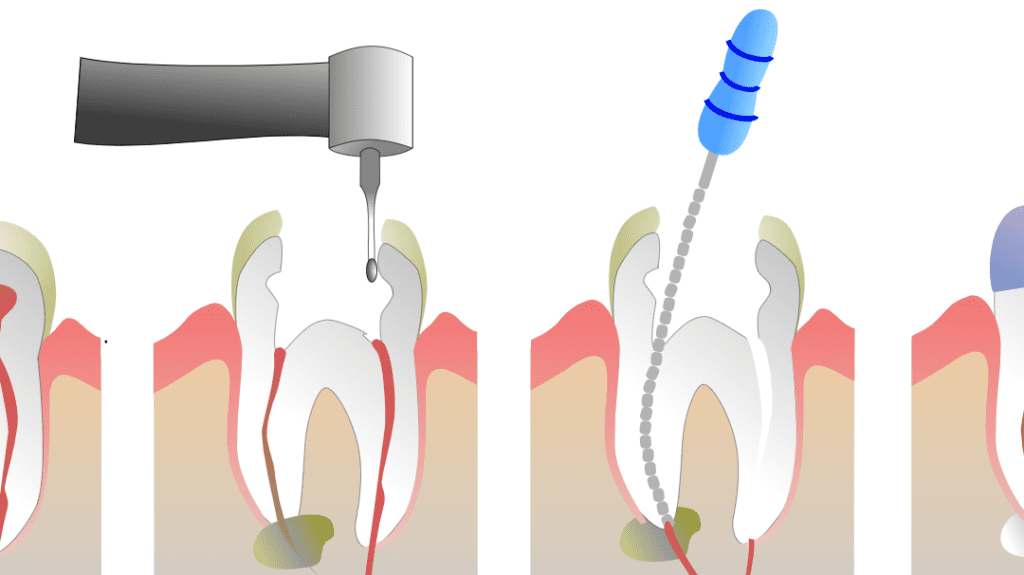
At this point, the specialist will make an opening through the crown of your tooth (if it is a molar) or behind the tooth (if it is one of the front teeth) to gain access to the pulp chamber.

5. Cleaning the tooth

Once inside the pulp chamber, the next step is to use small instruments to enlarge, shape, and clean the root canals. The infected or decaying pulp tissues will be removed from the tooth before the entire area is flushed and cleaned. Afterwards, the canals will be disinfected. For this step of the root canal process, Dr. Mitchell uses laser dentistry technology called Waterlase. Waterlase dentistry is one of the most advanced dental treatments available to Dentists today. Waterlase uses a patented technology that combines focused light energy with a stream of water for a highly precise, exceptionally gentle dental experience.

6. Sealing the tooth

When the area has been thoroughly cleaned, the next stage will be to fill up the tooth with a thermoplastic material called gutta-percha. This material is heated and compressed into the root canal and sealed inside using adhesive cement referred to as a sealer.

7. Finishing the Procedure

At the end of the treatment, the drilled hole is filled with a temporary filling and the dental dam is removed. The endodontist may prescribe some medication to help prevent infection. You will then be sent to a general dentist for a permanent restoration of the tooth either using filling material or a crown. After this, the treatment is complete.

It is important to note that sometimes it takes only one visit for the root canal treatment to be completed; whereas, in other cases, it may take two or three more visits. Don’t worry if you feel a bit of pain and tenderness on your tooth after treatment. This can be resolved with some over-the-counter painkillers. Root canal treatments are meant to last for many years. Nevertheless, a re-evaluation can be set up periodically to determine the status of the treatment.


Frequently Asked Questions

It is a branch of dentistry that specializes in the cause, prevention and treatment of diseases of the human dental pulp and the surrounding bone and tissue.

A specialist in the treatment of diseases and injuries to the root and surrounding bone and tissues. An endodontist is a dentist who receives 2-3 years of specialty training after dental school, and often after a hospital based residency in general dentistry in an accredited dental school.

To become Board Certified, an endodontist must meet the following requirements: Complete a postdoctoral study in an ADA approved program and be identified with endodontics for at least four years. Demonstrate high moral, ethical and professional qualifications and hold a valid license to practice endodontics. Pass an extensive written exam that tests a broad range of fields including anatomy, biochemistry, pathology, immunology, microbiology, radiology, pharmacology, statistics, clinical endodontics, and related medical disciplines. Submit documentation of a variety of cases from his/her own practice. These cases must be diverse and complex enough to demonstrate exceptional knowledge, skill and expertise in the full scope of the field of endodontics. Complete an oral exam given by a team of experts in the field. Throughout this intensive interview, a high level of problem solving, decision-making, analysis, creativity, diagnosis and treatment must be demonstrated.

Founded in 1964, the American Board of Endodontics is the only certifying board in the dental specialty of Endodontics recognized by the American Dental Association and the American Association of Endodontists. The purpose of the ABE is to assure the public that the endodontists it certifies have demonstrated exceptional knowledge, skill and expertise in the specialty of endodontics and to progressively raise the quality of patient care.

All dentists receive training in endodontic treatment in dental school. However, because of specialized equipment and advanced education and training in root canal techniques and procedures, many dentists refer patients needing endodontic treatment to an endodontic specialist.

The length of time to do each procedure varies. Each tooth is different with unique anatomy and conditions. The number of roots involved, the condition of the roots, infection, accessibility, all determine the time needed. Many treatments are completed in one visit, but some cases will require additional visits. Visits can take from approximately 1 hour to over 2 hours.

It is not uncommon to experience moderate discomfort and sensitivity, and tenderness to touch and chewing after your initial visit. The discomfort will gradually decrease over the following 5 to 7 days. The first choice for pain relief is Ibuprofen. If you cannot take Ibuprofen, we recommend Acetaminophen. You should ask your physician prior to taking any of these medications.

You should schedule an appointment to see your dentist within 30 days of your root canal treatment. It is important to protect the remaining tooth structure with a permanent restoration. A crown is usually recommended after root canal treatment.

After root canal treatment, your tooth will have a temporary filling inserted. After time, food debris and bacteria will contaminate the root canal system. This will result in treatment failure and often another root canal will need to be done – at additional expense and time. If the damage is too severe, extraction becomes the only choice. Your tooth can also fracture if not permanently restored in a timely manner. This too may result in extraction.